
Image of The Most Holy Saviour
Through the three grated windows at the top of the “Scala Santa” (Holy Stairs) we view the chapel known as the “HOLY OF HOLIES”. In the Middle Ages this chapel served as the private oratory of the Popes in the Lateran palace (Patriarch’io). Originally, the chapel was dedicated to the Roman martyr, St. Lawrence. It was probably built before the eighth century, since the first documented record appears at about that time. The chapel was first referred to as the SANCTA SANCTORUM in the ninth century because of the numerous and notable relics which were kept behind a heavily grilled casing beneath the altar.
Later documentation evidences the prominence of the chapel for the solemn papal liturgies celebrated there, especially during Holy Week. “In the whole world no place is as sacred as this” these were the words inscribed on the cosmatesque architrave above the altar during the papacy of Sixtus V (1585-1590). It is an appropriate affirmation still valid today. Many precious reliquaries were transferred to the Vatican in 1905, but the relics remained in the chapel.
The present architectural structure bears no similarity to the original. Due to the damage inflicted by the earthquake of 1277, by commission of Pope Nicholas III (1277-1280) the chapel was restored by a certain Master Cosmatus in the gothic style, at the time a rarity in Rome. After the pictorial- architectural restoration completed in 1994, we today are able to fully appreciate the work of Cosmatus. Inside the chapel we admire the splendid geometrically-designed pavement with its “fragments” of porphyry and inlaid multicolored pieces; one of the best examples of the cosmatesque in Rome. To a height of about 4 meters, the lower walls are panelled with the marble called “pavonazzetto”.
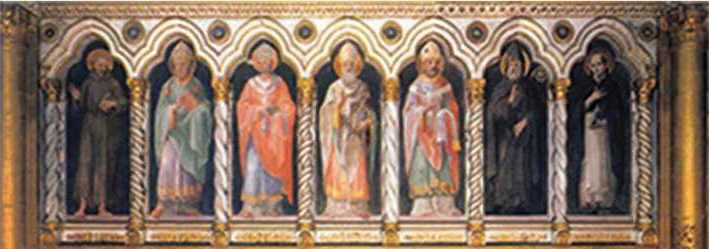
Recent restoration and research substantiate that the decorations of the upper walls and the vault, of capital importance for the development of art in Italy, were the work of an unknown group of Roman artist of the late thirteenth century. The mosaics are of the same period. The figures of the apostles and saints on the upper walls, framed between serpentine gothic columns, have been identified as the work of a group of “sistine” artists who, toward the end of the sixteenth century, also decorated the walls above the Scala Santa in striking frescoes. This chapel, called by Gregorovius “the most venerated shrine in Rome”, was open to the public until the sixteenth century; the wornout pavement an indication of the huge crowds which frequented the shrine.
Image of The Most Holy Saviour
Of the sacred objects preserved in the chapel of the Sancta Sanctorum, the most ancient, well-known and venerated is the IMAGE OF THE MOST HOLY SAVIOUR, the revered ACHEROPITA, that is, “not painted by human hand”, according to a popular medieval tradition. The heart of devotion as well as of the art in the chapel, this image hangs behind the papal altar. It was mentioned for the first time in the Liber Pontifical is around the middle of the eighth century during the pontificate of Stephen II (752-757). Barefoot, he himself carried it in procession through the streets of Rome to invoke divine protection against king Aistulf and his Lombard hordes.
The image is thought to have originated in Rome between the fifth and sixth centuries. Today we can barely see the slightest traces of Christ seated on a throne, surrounded by an aura in the form of a cross, in the classical pose of the Lord, with the scroll of the law in the left hand, his right hand extended in blessing. Restored on many occasions, it was completely altered when Alexander III (1159-1181) had silk placed over the original on to which the image we see today was painted. In turn, Innocent III (1189-1216) covered the sacred image with a plate of hammered silver. Over the centuries this, too, was further embellished; the results not always stylistically harmonious. The beaten silver doors which protect the image are of the fifteenth century. The present metal and gilt wood canopy over the altar replaces that of Caradossi (1452-1527) which was lost during the “sack” of Rome in 1527.
Though no longer the object of special liturgical celebrations as in the past, this image is still venerated by the Roman faithful who are devoted to it as their anchor of safety in times of public calamities and other historical episodes of the city. This devotion has its parallel in Rome with the Madonna, “Salus Populi Romani” (Salvation of Roman people), of Saint Mary Major.
SCALA SANTA (The Holy Stairs)
According to an ancient Christian tradition, Saint Helena, the mother of Constantine, brought the stairs from Pontius Pilate’s palace in Jerusalem to Rome in 326. They consist of 28 marble steps reputed to have been those of the governor Pontius Pilate’s palace (Praetorium), and to have been ascended and descended by our Savior during His Passion. The Holy Stairs are covered with walnut woodwork and, out of devotion, are ascended by the penitent faithful on their knees. Between the years 1586 and 1589, Sixtus V built the shrine as it is today and placed the Holy Stairs at their present site as an approach to the Sancta Sanctorum. In the year 1853-1854, Pius IX (1846-1878) had the adjacent monastery built. Both monastery and shrine have been entrusted to the Passionist community “in perpetuum”.